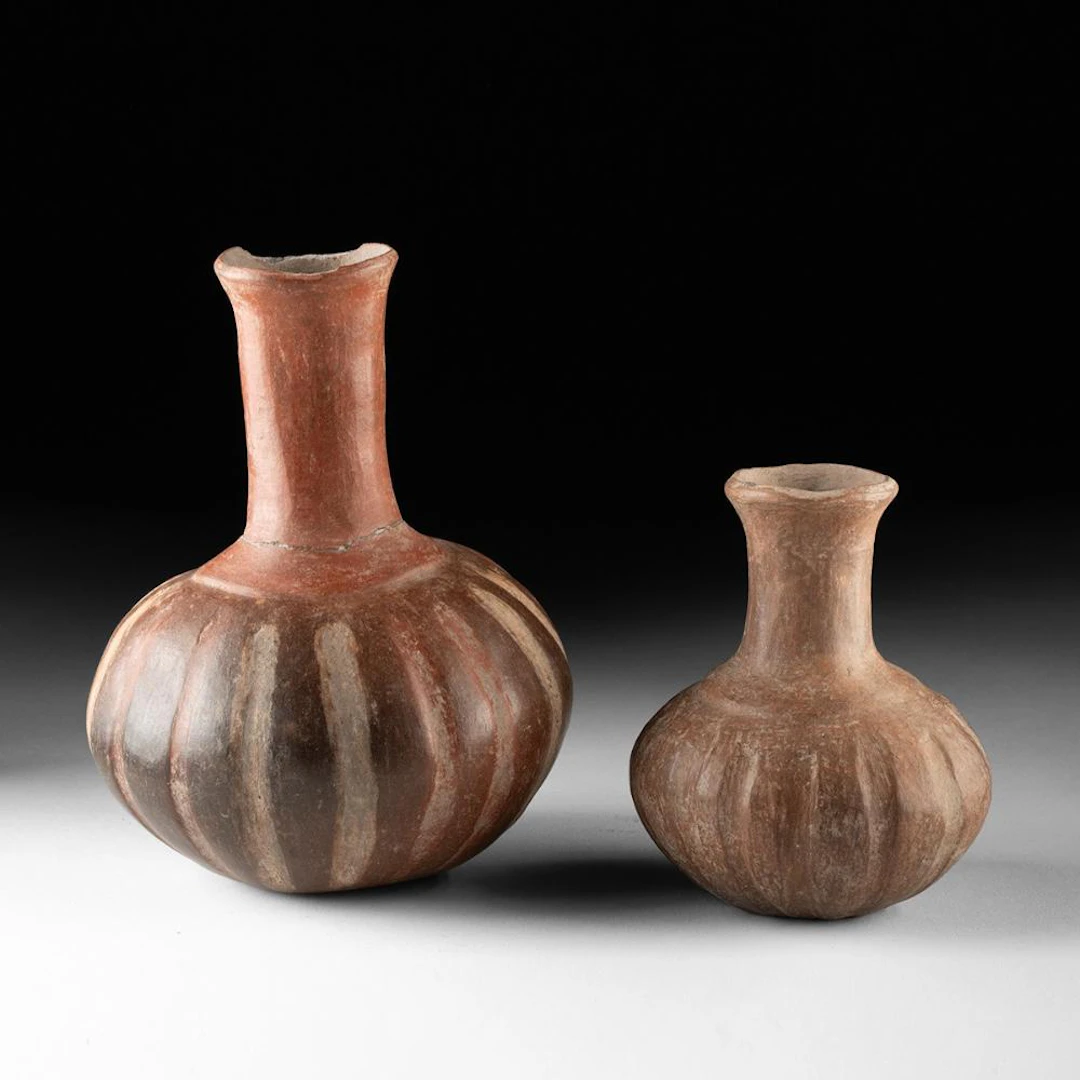
Pre-Columbian Bottles, Calabash Form, Tlatilco and Colima Ware
Pre-Columbian, Mexico, Tlatilco and Colima. A pair of hand-built earthenware bottles whose swelling bodies imitate the ribbed shell of a bottle gourd, each rising to a tall cylindrical neck and everted lip. The larger vessel carries burnished red slip across neck and shoulder, its lower body divided by broad cream and dark brown vertical bands that follow the modeled lobes, a resist or slip-painted scheme that heightens the botanical illusion. The smaller, more petite bottle is finished in a warm buff-to-russet slip with the same fluted swell but no polychrome banding. Both derive from the everyday calabash containers used throughout ancient Mexico for water and fermented drink, translated into fired clay for household use and, ultimately, for deposit in shaft or pit tombs alongside the dead. The gourd was the first vessel of Mesoamerica, and potters never stopped quoting it. Tlatilco, a Formative period village on the western edge of the Basin of Mexico, produced some of the earliest and most inventive skeuomorphic ceramics in the Americas, translating squash, gourd, fish, and human bodies into burnished, slip-banded clay. Colima potters of West Mexico, working a millennium later, pursued the same botanical vocabulary in their highly burnished redwares, which were placed by the dozen in the deep shaft tombs that define the Comala and related phases. A shared form, separated by centuries and several hundred miles, and answering the same practical question of how to carry liquid. Item # 204266
估價:$300
前往拍賣頁查看所有物品來自Artemis Fine Arts或Porcelain & Pottery