History
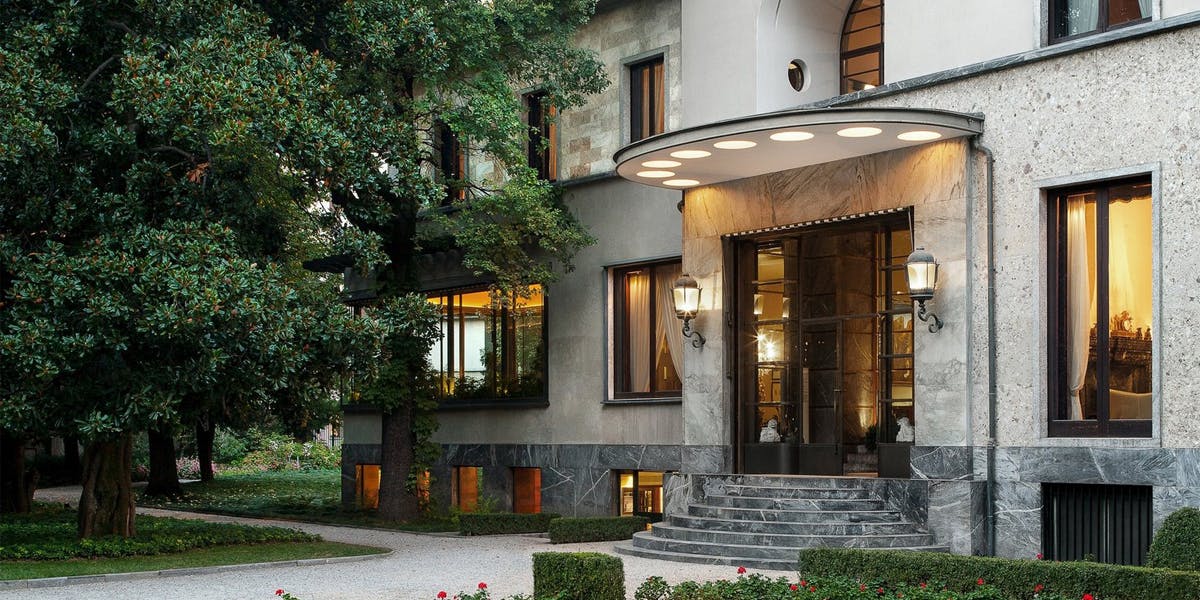
Villa Necchi Campiglio is a historic residence and house museum that has constituted the ‘Case Museo di Milano’ (historic houses of Milan) circuit since 2008. One of Milan’s best-hidden treasures, the house is a wonderfully accomplished and luxurious example of Italian interwar-period architecture. Stark, imposing and compassed by a sprawling garden, the house also accommodates a tennis court and Milan’s first private swimming pool. Once home to the illustrious Necchi Campiglio family – renowned members of the Lombard industrial bourgeoisie – it was conceived by Milanese architect Piero Portaluppi between 1932 and 1935, with subsequent renovations by Tommaso Buzzi. It marks the introduction of Rationalism into modern Italian architecture.
Related: A Designer’s Dream Hotel Becomes a Reality
Conceived as a sort of country house within Milan’s bustling city center, the choice of location of villa Necchi Campiglio was no coincidence. In the late 19th century, the villa’s surroundings were still largely occupied by gardens despite their adjacency to the city centre. The area, central yet quiet and wooded, appeared attractive to Angelo Campiglio and the Necchi sisters, who, hailing from Pavia, were seeking a home in Milan to entertain their gaggle of elite relations. Exponents of the cultured Lombard industrial bourgeoisie, the Necchi sisters, Gigina (1901-2001) and Nedda (1900-1993) inherited a fortune from their brother’s sewing machine company (the famous Necchi brand sewing machines) and their father’s cast iron foundry, which Angelo Campigio (1891-1984) began working for after marrying Gigina.
When the land was purchased around 1930, the house’s design was entrusted to the architect Piero Portaluppi, one of the most renowned Italian architects of his time, and construction ensued between 1932 and 1935, courtesy of the Gadola company. Portaluppi was hired to design Villa Necchi Campiglio as a total work of art, reflecting the Milanese high society lifestyle and modern trends of the time – Italian rationalism, fascist architecture and Art Deco.
All of the villa’s details were personally designed by Portaluppi, from the door handles to the window frames. The house was conceived as an elegant but practical residence and is modern both in its style and in its systems and equipment. It is fitted with a plethora of modern apparatuses: pocket sliding doors, electric shutters, an elevator, a dumbwaiter, central heating and an expansive intercom system for the house staff.
During the Second World War, the family fled to the city of Barasso in the Varese area, and the house in Milan was requisitioned, becoming Italian fascist statesman Alessandro Pavolini’s residence and headquarters. Following the Republic of Salò’s fall, it was first occupied by the English before it was converted into the Dutch consul’s domicile. The family returned from their home in the countryside in the early ‘50s and managed to regain possession of the villa.
Related: Inside a Designer's Punk-Inspired Italian Home
When the Necchi Campiglios recovered the house after the war, they decided to refurbish the villa’s interiors to befit the more classical 18th-century design of Italian palazzos. The architect Tomaso Buzzi (known for the conception of Villa Volpi) was commissioned to refurbish the exterior and then remodel a few of the rooms in a softer and more ornamental style than Portaluppi’s.
Related: Accommodation Meets Art: 7 of the Most Creative Hotels in the World
Angelo Campiglio died in 1984, followed by Nedda Necchi in 1993 and her sister Gigina in 2001. The sisters’ lack of offspring informed their decision to bequeath it to the FAI (Italian National Trust). The villa subsequently underwent restoration under architect Piero Castellini’s direction. The renovation was conducted over three years, amounting to roughly €6 million in expenses. The home finally opened to the public in May 2008.
Setting

Villa Necchi Campiglio stands out from the other Case Museo of Milan thanks to its status as an independent single-family dwelling, rather than a palazzo in the likes of the Poldi Pezzoli Museum and the Bagatti Valsecchi Museum, or an apartment such as the Boschi Di Stefano museum-home (also designed by Portaluppi).
Want more articles like this straight to your inbox? Subscribe to our free newsletter!
The villa is located in Milan’s city centre (in the historic Monforte area), a few minutes walking distance from the Duomo di Milano. It presides over a peaceful block nicknamed ‘the Block of Silence’ known for its concentration in aristocratic residences. The house itself is positioned arrear the road and is protected by a towering wall, ensuring the tranquillity and privacy of its guests and inhabitants. Its street entrance features a small separate building, employed as a porter's lodge and garage and connected to the villa by an underground passage.
Related: Step inside the Tuscany Home of Cheap Monday’s Founders
The house is surrounded by lush and expansive gardens complete with a tennis court and Milan’s first private heated pool. At the time, these features could only be found in country houses or mountain chalets. Today, the garden also hosts a café as well as a glass pavilion-domed tennis court donated by Giorgio Armani in 2015.
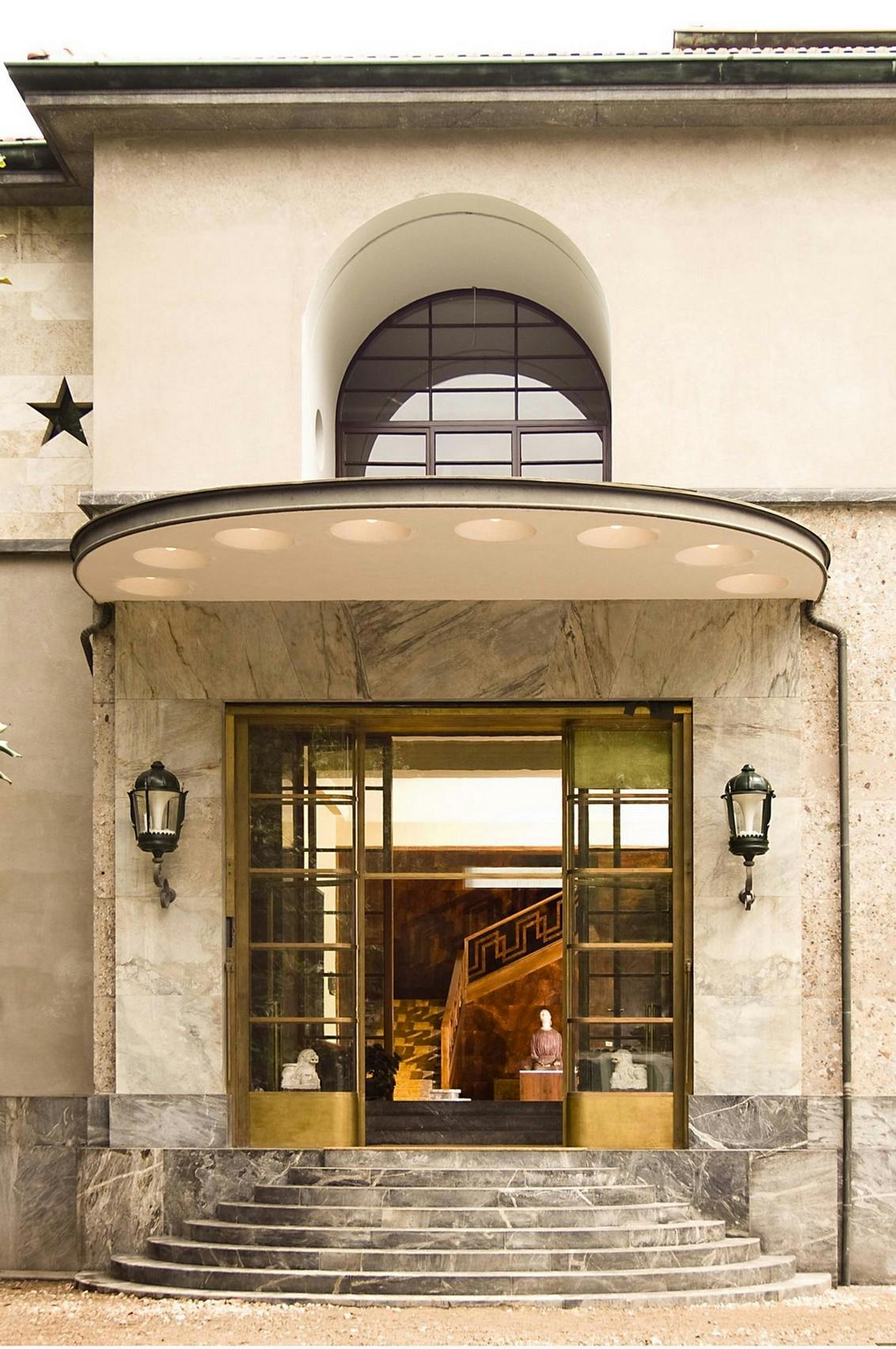
The building’s exterior is typical of the austere style of the then nascent rationalism, with each floor gilded in a different material (granite and marble) and color, while its interiors are characterized by elements of Art Deco. The entrance is sealed by an imposing glass and iron door that leads into the atrium.
Related: Art Deco: The Great Celebration
Designed for hosting, in its heyday, the villa Necchi Campiglio housed a rota of notable guests such as Princess Marie-Gabrielle of Savoy, the Viscontis and the king and queen of Spain.
Basement
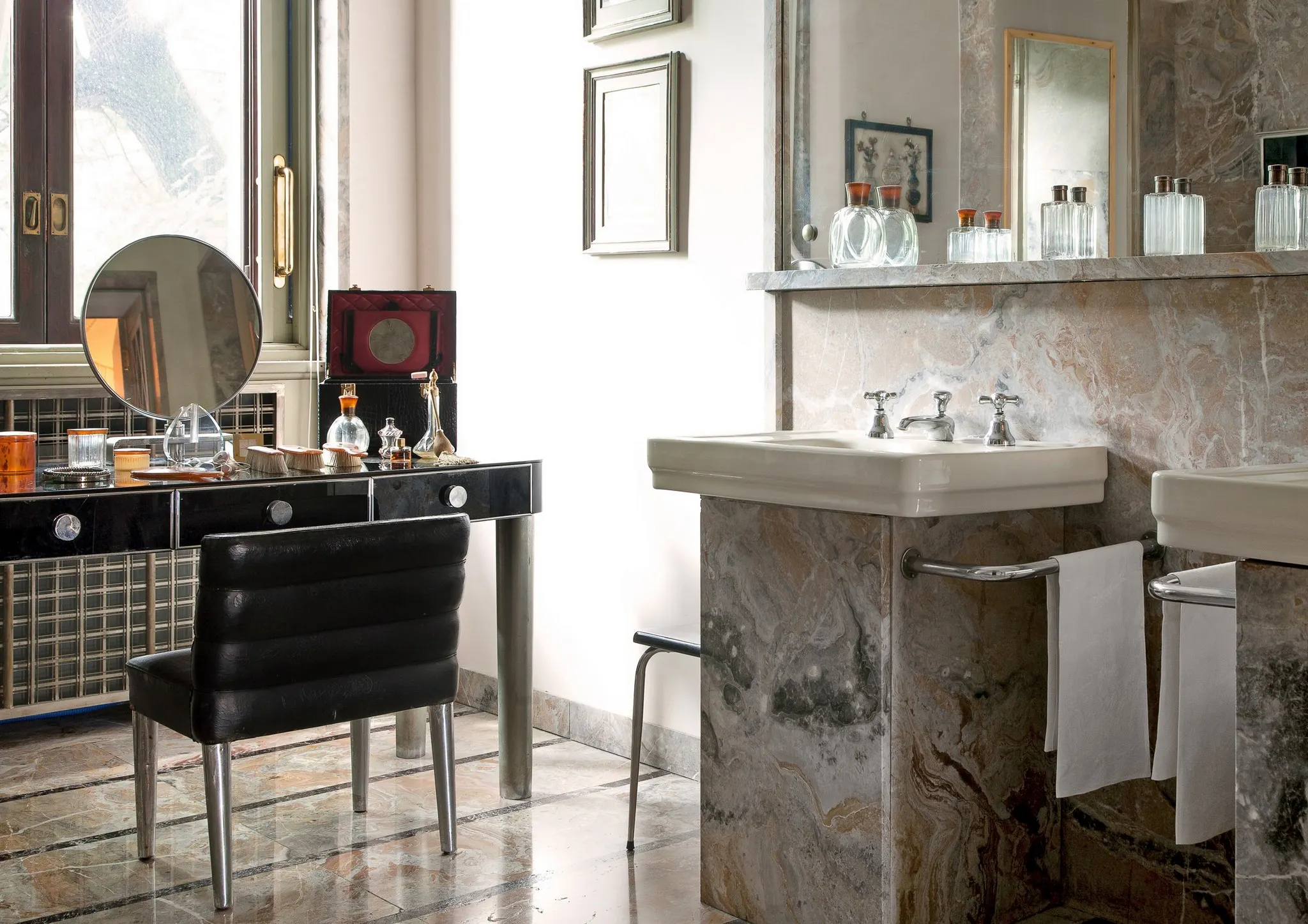
The basement consists largely of the servants quarters and service rooms. However, true to the house's divertissement bent, it also comprises a billiard room. Today, a permanent photographic exhibition of the villa’s history occupies yet another room on this floor.
Mezzanine

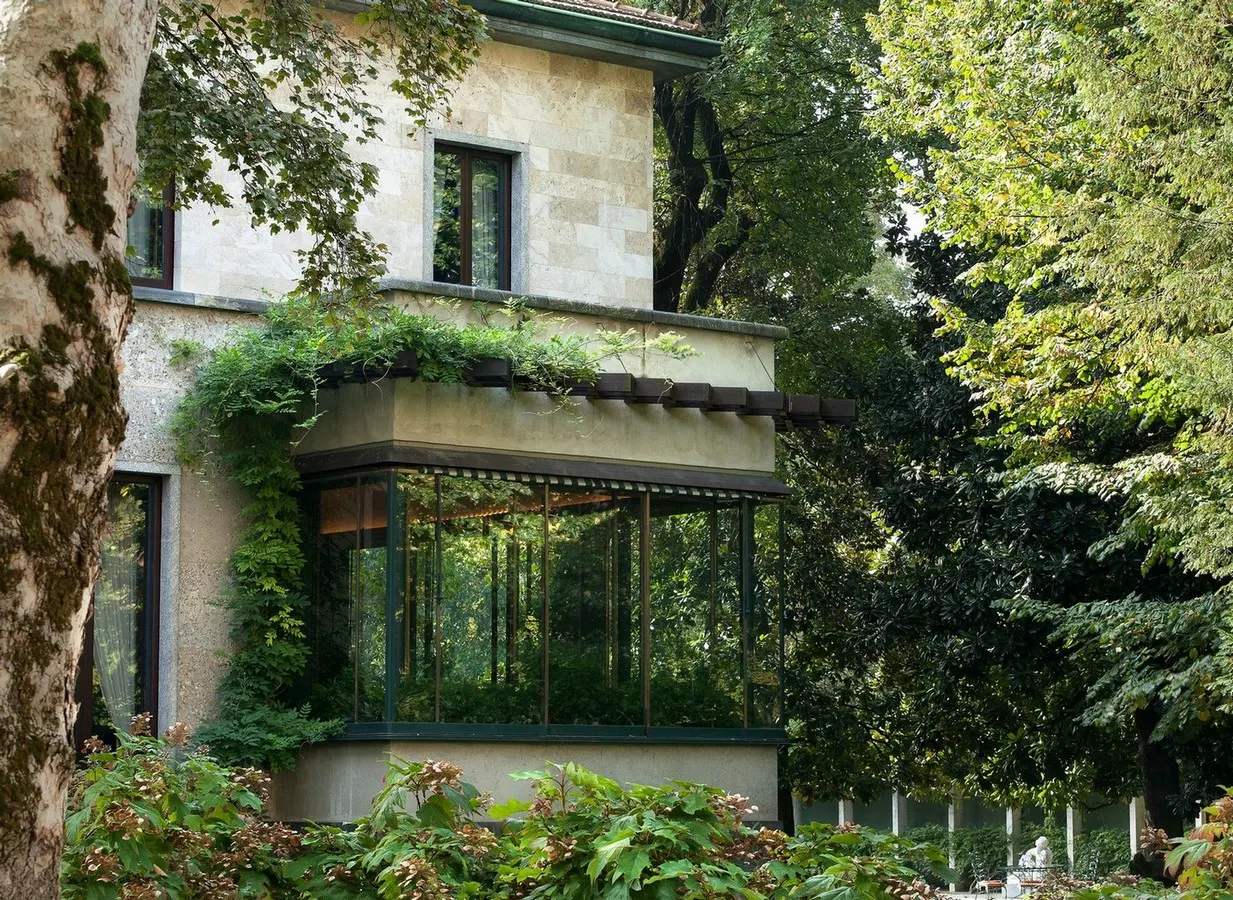
The main entrance leads into a large atrium paved in walnut and rosewood; the general effect is one of imposing splendor and opulence. It is easy to imagine the Necchi Campiglio’s bevy of well-dressed guests waltzing in. To the left is a library made intimate by its diamond-patterned stucco ceilings and wall-to-wall rosewood bookcases. Gulemigo Ulrich gaming tables complete the affair, ensuring that guests were able to indulge in more than just quiet reflection. Beyond the library lies the house’s most Instagrammable feature: a conservatory veranda. Tall, double pane glass windows give onto the splendid garden and travertine and green marble flooring elegantly envelop the small greenhouse.
Related: A Spectacular Art Villa Under the Tuscan Sun
The living room redecorated by Tomaso Buzzi is furnished in a rich and ornamental style of 18th-century inspiration. The atrium on the right leads to the fumoir, a small lounge also refurbished by Buzzi, accented by a large Renaissance-style fireplace. Adjacent to the lounge is the dining room, its walls clad in vellum. The stucco ceiling above is covered in astrological motifs. This room also stars Buzzi’s touch: the walls are dressed in Belgian tapestries from the 16th to 17th centuries. The atrium also leads to Angelo Campiglio’s wood-lined office, where a mechanical oval desk produced by the Tuscan cabinetmaker Giovanni Socci commands its centre.
First Floor

A grand marble staircase framed by a gold-detailed Greek double balustrade leads from the atrium to the first floor. Two master apartments are arranged symmetrically on either side of a barrel-vaulted corridor lined in wall-to-wall cupboards. The wall to wall cupboards display the Necchi sister’s impressive collection of couture, featuring an impressive array of custom Gucci, Dior and Hermès.
The two bathroom-equipped guest rooms are accessed from the central hallway. The smaller one was nicknamed the Prince’s room after its regular occupant, the Prince Heinrich of Hesse-Kassel. The second bedroom, in the southwest corner of the building, is named the Princess’ Room after Princess Maria Gabriella di Savoia; today it accommodates the Micheli collection. Adjacent to the Princess’ room lies a wardrobe and ironing room, occupied, in accordance with the customs of the time, by the only servant permitted to stay on the masters’ floor.
Collections
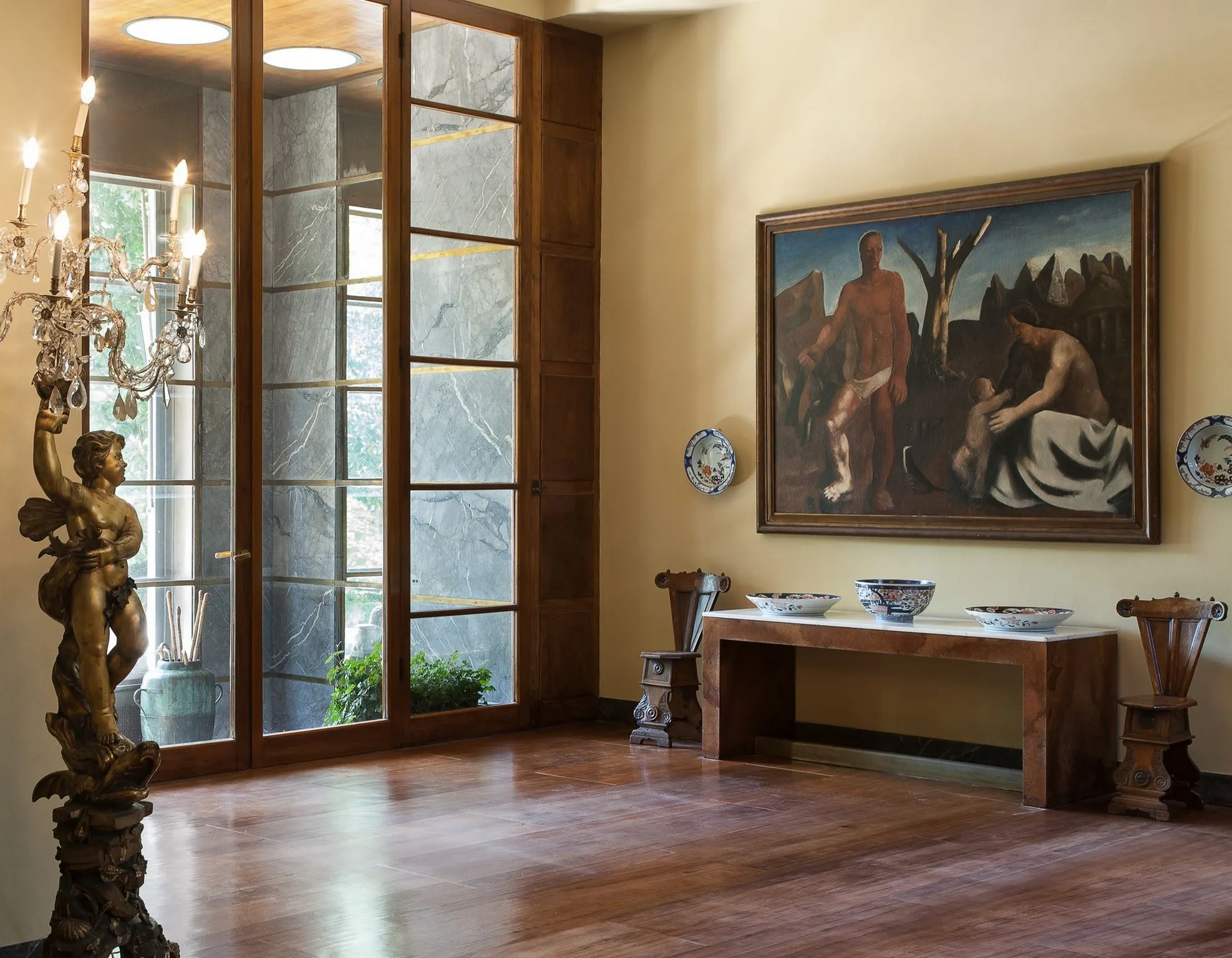
A magnificent work of art in itself, the villa is enriched by numerous paintings, sculptures, furnishings and other valuable objects. The collection was partly purchased by the Necchi-Campiglio during their occupancy and partly donated to the FAI, which placed them in the house. Among the donations to the FAI are Claudia Gian Ferrari’s early-20th-century collection, and Alighiero and Emilietta De Micheli’s collection of 18th-century paintings and decorative arts. The most notable item in the collection is Arturo Matini’s L’Amante Morta sculpture, which rests in the alcove at the foot of the stairwell.
Nedda Necchi’s collection of 20th-century art pieces – containing, among other things, works by Jean Arp, Gianni Dova, Lucio Fontana, Roberto Crippa, Mario Sironi, René Magritte – disunited when she chose to sell the pieces to finance research at her friend Umberto Veronesi's Institute. However, she retained the sole existing work of painter Giuseppe Amisani, entitled Il Cardinale Richelieu, which hangs in her bedroom.
The Claudia Gian Ferrari collection
Permanently bequeathed to the FAI by art gallery owner and art historian Claudia Gian Ferrari, the collection includes 44 paintings, drawings and sculptures by early-20th-century Italian artists, including Giacomo Balla, Umberto Boccioni, Carlo Carrà (Still life with books), Giorgio de Chirico (Oreste and Elettra, Portrait of Alfredo Casella), Filippo de Pisis (Still life with the hare), Arturo Martini (The dead lover, Busto di fanciulla), Giorgio Morandi (Still life, Two specimens), Mario Sironi (The shepherd's family), and Adolfo Wildt (The pure fool). All the works are placed in rooms on the mezzanine floor.
The Alighiero and Emilietta De Micheli collection
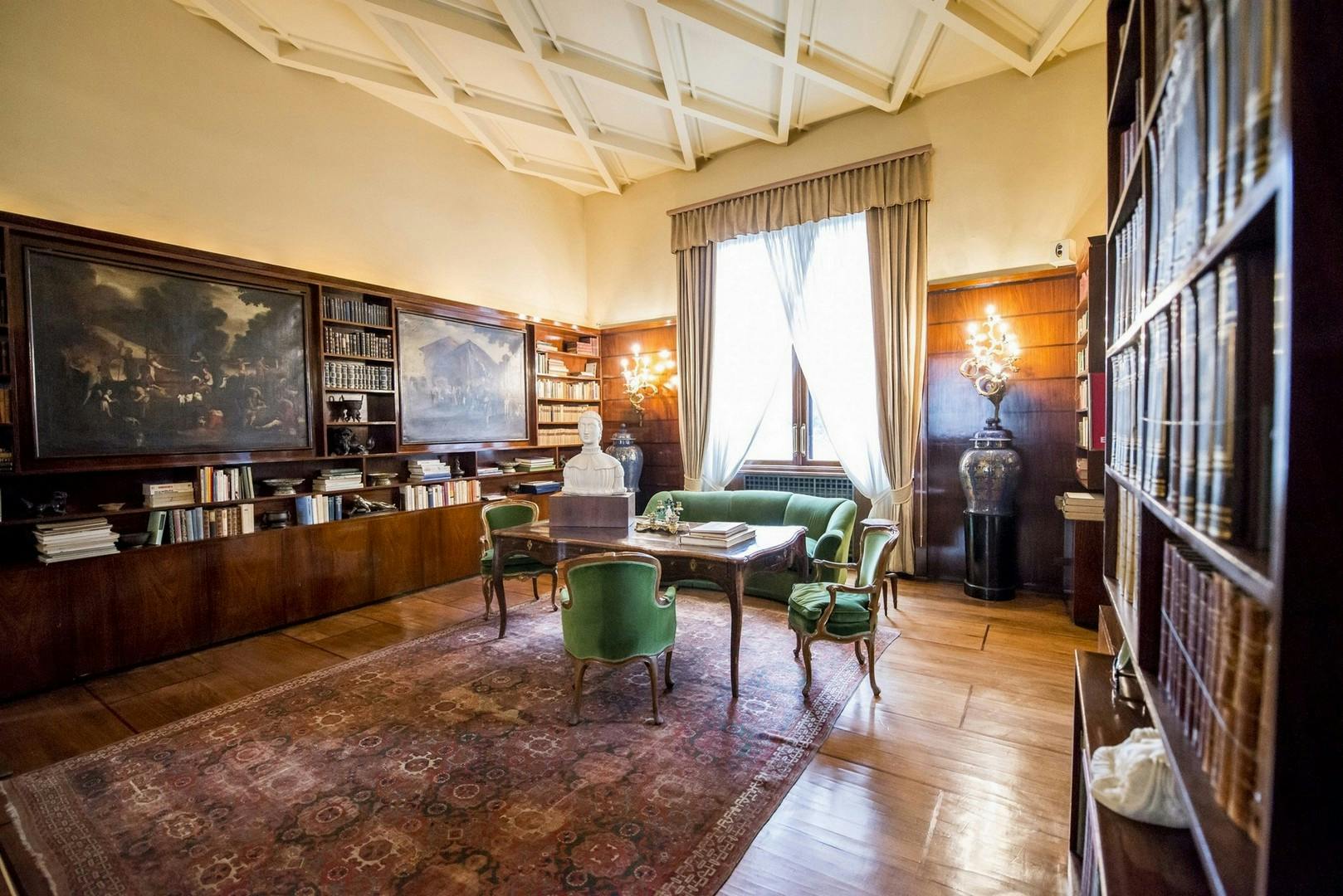
Textile industrialist and banker, Alighiero de Micheli’s (1904-1995) collection includes over 130 18th-century masterpieces, including paintings (Canaletto, Tiepolo and Rosalba Carriera), French furniture, Lombard ceramics, Chinese porcelain and rare miniatures by Jean Baptiste Isabey. The collection is kept in the Princess’ room, in an exhibition curated by the architect Filippo Perego which reflects the house’s original owners’ taste.
Filming location
The house was featured in Luca Guadagnino’s 2009 masterpiece, the critically acclaimed, I Am Love. The director stated he was drawn to the villa’s “restrained sensibility”, affirming that “it shows the obsession with perfection and details that the Milanese bourgeoisie have”.
Find more articles in Barnebys Magazine
Article by Noor de Falco
This is an updated version of an article originally published on June 28, 2021.